 sentiar
 Where EP innovation is actually happening
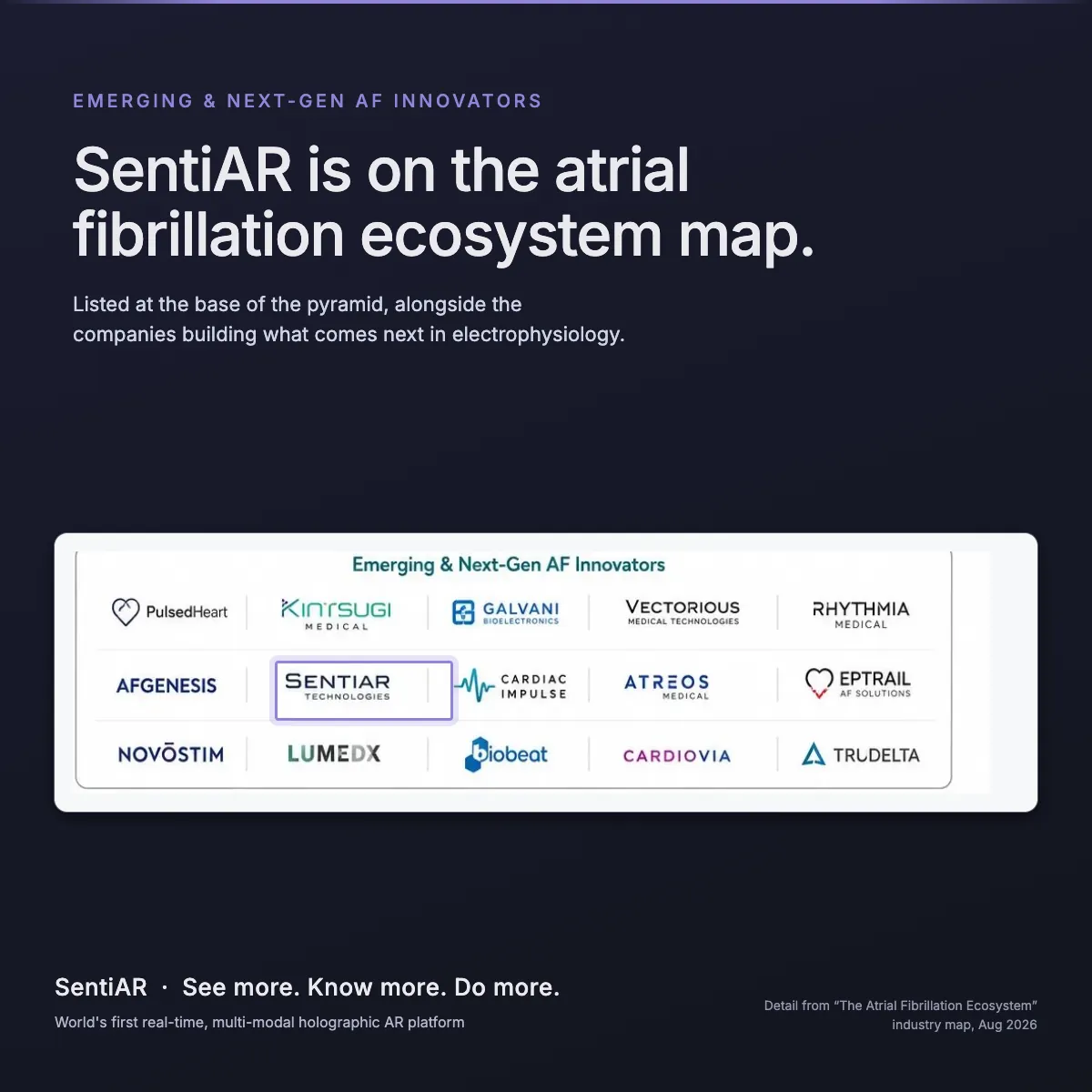
An industry map of the atrial fibrillation ecosystem, published in August 2026, lists SentiAR in its emerging and next-generation tier. The map is a useful picture of how care for atrial fibrillation is currently structured, and of where the open problems lie.
It is arranged as a pyramid. At the top sit the biopharma companies developing atrial fibrillation therapies. Below them are the device and drug makers working on rhythm management, rate control and stroke prevention, then the diagnostic and monitoring companies, the hospitals and specialty centers, the technology and research enablers, and the advocacy organizations. At the base is a tier the authors label Emerging and Next-Gen AF Innovators. SentiAR is listed there.
What the base tier is for
Every tier above the base is organized around something that already works at scale: a drug class, a catheter, a monitoring service, a hospital program. The base tier is organized around the parts that do not yet work well. In atrial fibrillation, those parts are reasonably well known. Ablation outcomes still vary with operator experience. The physician is separated from the map by a screen and by another person driving it. Consumer devices are detecting arrhythmia faster than clinics can triage it. Capital equipment keeps procedures locked inside a small number of purpose-built rooms.
Companies in the base tier are placed there because they are attacking one of those gaps rather than improving something already established. The tier is a statement about problem selection, not about size.
The gap we chose
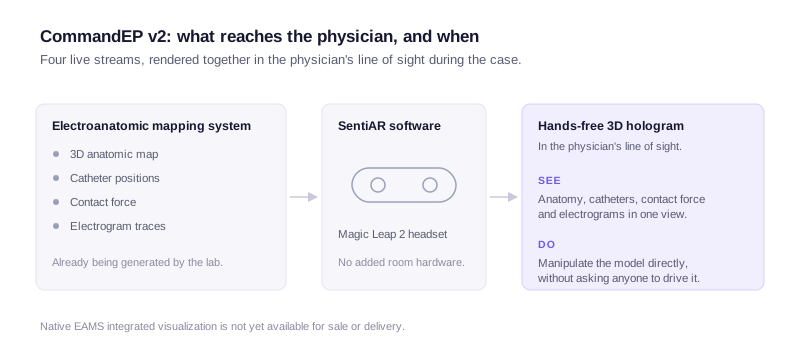
SentiAR builds the world’s first real-time, multi-modal holographic AR platform for the electrophysiology lab. CommandEP converts real-time catheter data into a hands-free three-dimensional view of the patient’s anatomy, under the physician’s own control. VistaMD places up to five virtual screens where the physician needs them, so a room does not need a ceiling full of hardware to function as an EP lab.

Preclinical animal laboratory, April 2024. Virtual screens combined with native EAMS integrated visualization are not yet available for sale or delivery.
Multi-modal is the operative word. The anatomy, catheter positions, contact force, and electrogram traces arrive together within the physician’s line of sight during the case. Nothing has to be requested from someone else, and nothing has to be read off a screen across the room.
What PARADIGM measured
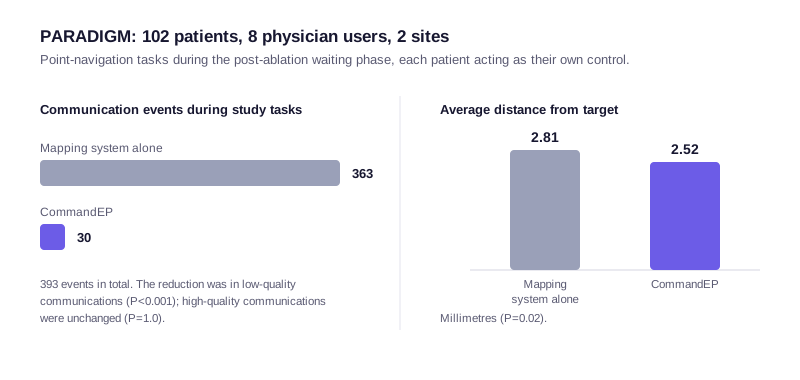
The PARADIGM study tested the first of those claims. It was a prospective, multicenter, two-treatment crossover feasibility study of CommandEP v2, run at two sites — Massachusetts General Hospital and Beth Israel Deaconess Medical Center — with 102 patients and 8 physician users, published in Circulation: Arrhythmia and Electrophysiology in April 2025.
During the post-ablation waiting phase, each physician navigated a catheter to a set of target points twice: once with the electroanatomic mapping system alone, and once with CommandEP. The order of the two conditions was randomized for each patient, so every patient served as their own control. Three results are worth repeating.
-
Navigation was more accurate with CommandEP, at an average distance from target of 2.52 mm against 2.81 mm for the mapping system alone (P=0.02), and 21 percent of points more than 4 mm from target against 28 percent (P=0.03).
-
Of 393 communications counted during the study tasks, 30 occurred while using CommandEP and 363 while using the mapping system. The reduction fell on low-quality communications — requests to change the view, size or transparency of the display (P<0.001). High-quality communications, those bearing on navigation, medical decision-making or patient care, were unchanged.
-
Of 102 post-procedure surveys, 94 percent agreed or strongly agreed that the physician felt comfortable using the system, and 72 percent that they would be comfortable using it in most or all EP studies.
The accuracy difference is statistically significant but small, and the authors describe it that way. It was concentrated in the more experienced users: every physician more than five years into practice navigated more accurately with CommandEP.
The communications result is the larger effect, and the more interesting one. It is a fairly direct measure of what changes when the physician controls the map instead of asking someone else to drive it — the requests that disappear are the ones that were only ever about moving a picture around. The authors note that technologies which cut low-quality communications may help procedural efficiency, and that the effect on team dynamics was noticeable.
Why the map is worth keeping
Maps like this one are snapshots, and the authors say as much. What makes this one useful is the shape, not the names. It shows an established industry with a wide, crowded middle and a thin base of companies working on parts of the pathway that established players are not positioned to change. Being counted in that base is a fair description of what we do.
See more. Know more. Do more.
SentiAR builds the world’s first real-time, multi-modal holographic AR platform, with real-time holographic guidance for cardiac electrophysiology. Two FDA-cleared products, based in St. Louis, Missouri.
Reference: Hanley A, Locke A, Singh J, Tung P, Hucker WJ, D’Angelo R, Avari Silva JN, Silva JR, d’Avila A, Michaud GF. The PARADIGM Study: Procedural Augmented Reality Assessment in a 3-Dimensional Image-Guided Modality. Circ Arrhythm Electrophysiol. 2025;18(4):e013222.
Virtual screens combined with native EAMS integrated visualization are not yet available for sale or delivery.