 sentiar
 What technology actually runs the OR and the EP lab in 2026
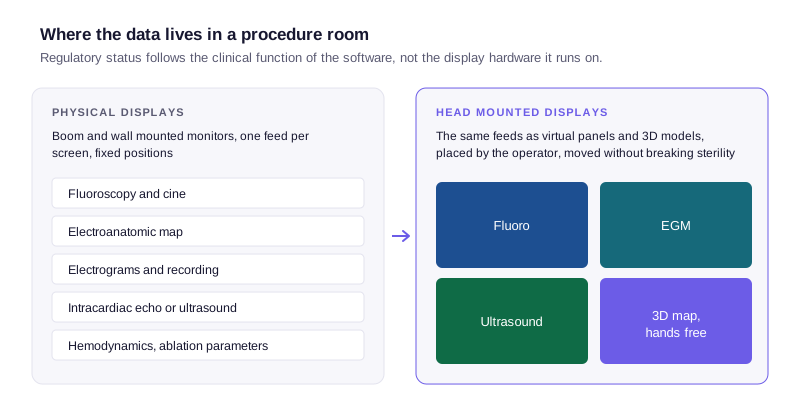
Walk into a modern EP lab, hybrid room, or interventional suite, and the technology is mostly the same everywhere. A fluoroscopy system with a flat-panel detector sits at the table. An electroanatomic mapping system builds the 3D model and tracks catheters. A recording system captures the electrograms. Intracardiac or surface ultrasound runs on its own cart. Hemodynamics, ablation generator parameters, pacing, and the electronic record each claim a feed. Those feeds terminate on boom-mounted or wall-mounted monitors, whose number and positions were decided when the room was built.
That architecture has two consequences. The first is ergonomic. The operator stands at the groin with hands in a sterile field and reads information displayed elsewhere in the room, which requires turning the head and asking someone else to rotate, zoom, or annotate the view. The second is financial. Display and boom infrastructure accounts for a meaningful share of a procedure room’s capital cost, which is precisely the constraint facing groups building ambulatory surgery centers now that payers cover more of these procedures outside the hospital.
Extended reality is arriving against that backdrop. The question is no longer whether a headset can render medical data. It is whether a headset can be part of a regulated, reimbursed, staffed procedure. On that question, there is now a real record.
How the FDA treats a headset
Regulatory status follows the clinical function of the software, not the display hardware it runs on. For a head-mounted display, the agency classifies these products by intended use and clinical function, not by the optics they use. The agency regulates a headset used for surgical navigation as a stereotactic navigation system. A headset used for pain therapy is regulated as a behavioral therapy device. The display is a component.
The volume is no longer small. The FDA public list of medical devices incorporating augmented and virtual reality technologies reached 104 entries by February 2026, up from 39 entries in December 2022. Most came through the 510(k) pathway, with two de novo authorizations. The entries span surgical navigation, therapeutic applications for pain and behavioral health, diagnostic imaging, ophthalmic treatment, and training.
Cleared systems and the hardware behind them
Cardiac electrophysiology. SentiAR received 510(k) clearance for CommandEP in 2020, the first holographic guidance system cleared for use during a minimally invasive EP procedure, followed by a second clearance in 2023 that added further mapping system integrations on new hardware. The system takes data from the electroanatomic mapping system and renders a real-time 3D image of the chamber with live catheter positions, controlled hands-free. The first clearance ran on Microsoft HoloLens. Version 2 runs on Magic Leap 2 with a gaze-and-dwell control method, and the virtual screen configuration has been described in the Journal of Interventional Cardiac Electrophysiology.*
Sports medicine. Stryker received FDA De Novo authorization on July 17, 2026, for SportSuite Vision, the first application authorized for intraoperative use with Apple Vision Pro. It brings arthroscopic video, CT imaging, and the company’s HipCheck and HipMap tools into a single spatial field of view. The first case, a hip arthroscopy, was completed at Duke Health and announced on September 1, 2026. Worth noting for anyone evaluating the model: the labeling still expects the rest of the team to work from conventional monitors.
Spine. Augmedics xvision uses a purpose-built, see-through visor for pedicle screw navigation and is the most widely deployed AR navigation system in spine. Novarad VisAR was cleared in 2022 and converts imaging into a hologram registered to the patient using CT-visible fiducials, with reported setup time under two minutes and roughly 96 percent screw placement accuracy in a 124-screw series. Holo Portal, an earlier-cleared spine platform, has reported 97 to 98 percent screw accuracy in early series. OnPoint and Philips ClarifEye occupy the same space with different registration approaches.
Cranial neurosurgery. Medivis received 510(k) clearance for Cranial Navigation in December 2025, the first AR system cleared for intraoperative guidance in cranial neurosurgery, following its Spine Navigation clearance earlier that year. The company highlights portability as the differentiator, including bedside use in the ICU, and notes that both clearances can support reimbursement under the existing CPT add-on codes 61781 and 61783.
Orthopedics and ASCs. Pixee Medical received 510(k) clearance in May 2026 for Knee+ NexSight for total knee arthroplasty on a new AR platform for smart glasses. Pixee Medical is explicit that the target is the ambulatory surgery center, where efficiency and cost control drive purchasing.
Interventional suites. MediView XR integrated its OmnifyXR interventional suite with GE HealthCare angiography systems, allowing the operator to view and manipulate 3D images by hand without breaking sterility. In parallel, the more conventional path to better visualization is advancing quickly: Philips received clearance in March 2026 for EchoNavigator R5.0 with DeviceGuide, developed with Edwards Lifesciences, which uses AI to align echo and fluoroscopy with the therapy device during mitral edge-to-edge repair.
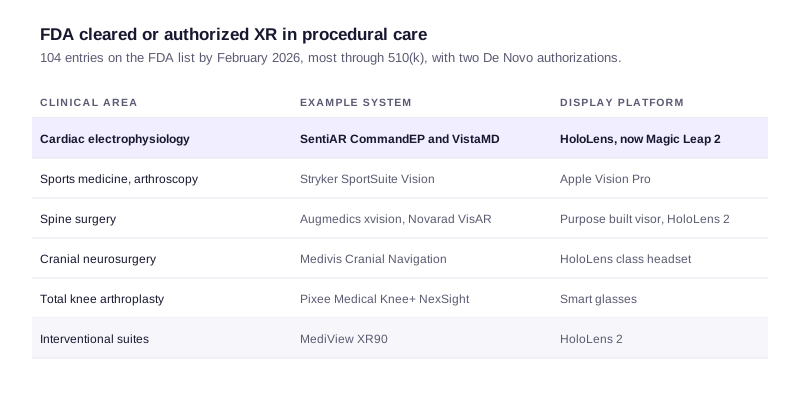
The FDA list of devices incorporating AR and VR reached 104 entries by February 2026, most cleared through 510(k), with two De Novo authorizations.
What the evidence shows
The PARADIGM study, published in Circulation: Arrhythmia and Electrophysiology in 2025, was a prospective, randomized, multicenter crossover study at Massachusetts General Hospital and Beth Israel Deaconess Medical Center, involving 102 patients and 8 electrophysiologists. During the navigation tasks, points more than 4 mm from the target fell from 28 percent to 21 percent; average distance from target improved from 2.81 mm to 2.52 mm; and low quality communications were reduced, dropping total communication events from 363 to 30. Ninety-four percent of the post-procedure surveys reported the physician was comfortable using the system.
Outside cardiology, the literature is younger but consistent in direction: accuracy at or better than conventional navigation in spine series, faster setup, and less attention shifted away from the field. A study in Surgical Endoscopy reported that surgeons used a passthrough headset as the primary monitor across 41 minimally invasive general surgery procedures. Most of these series are small, and several of the strongest claims come from manufacturers rather than independent trials, a fair caveat to carry into any evaluation.
The hardware question nobody can avoid
Cleared software outlasts consumer hardware cycles. Microsoft ended HoloLens 2 production and set an end-of-support date of December 31, 2027, with no successor announced. A number of cleared medical products were built on that headset and are now migrating. Magic Leap 2 remains the optical see-through option used in regulated cardiac work. Apple Vision Pro entered the operating room through the Stryker authorization. Vuzix-class smart glasses carry lightweight navigation overlays.
For a health system or an ASC, the practical question is not which headset is best in the abstract. It is whether the vendor has a hardware roadmap, a service agreement, and a plan for the day the current device reaches end of life. Ask for that in writing.
What readiness actually requires
Five things determine whether a room is ready. Sterility and draping, because a headset must be donned, adjusted, and tolerated for the duration of a case. Team visibility, because the operator seeing more does not help if the rest of the room sees less. Integration, because a display that cannot receive the mapping, imaging, and hemodynamic feeds is a novelty. Reimbursement and capital, because the business case is usually built on displays and booms that do not have to be purchased. And training, because gaze or gesture control is a new motor skill for the operator and a new workflow for the staff.
None of those are research problems anymore. They are procurement and process questions, which shows how far this category has moved in four years.
See more. Know more. Do more.
SentiAR builds the world’s first real-time, multi-modal holographic AR platform, with real-time holographic guidance for cardiac electrophysiology. Two FDA-cleared products, based in St. Louis, Missouri.
Sources
- FDA public list of medical devices incorporating augmented reality and virtual reality technologies; Exponent analysis, February 2026; MedDeviceGuide regulatory guide, 2026.
- SentiAR 510(k) clearance of CommandEP, 2020, and second clearance, 2023; DAIC, BioSTL, Auganix and Radiology Business coverage.
- Virtual screens for cardiac ablation procedures in augmented reality, Journal of Interventional Cardiac Electrophysiology, 2025.
- Hanley A, Locke A, Singh J, Tung P, Hucker WJ, D’Angelo R, Avari Silva JN, Silva JR, d’Avila A, Michaud GF. The PARADIGM Study: Procedural Augmented Reality Assessment in a 3-Dimensional Image-Guided Modality. Circ Arrhythm Electrophysiol. 2025;18(4):e013222.
- Stryker press release, first FDA authorized surgical application for Apple Vision Pro, September 1, 2026; FDA De Novo authorization July 17, 2026.
- Medivis press release, first FDA clearance for augmented reality navigation in neurosurgery, December 2025.
- Novarad VisAR 510(k) clearance announcement and Fierce Biotech coverage, 2022; Augmented reality surgical navigation review, 2026.
- Pixee Medical Knee+ NexSight clearance, regulatory roundup, May 2026.
- Philips press release, EchoNavigator R5.0 with DeviceGuide clearance, March 2026.
- Cardiovascular Business, FDA cleared AR and VR tools in cardiology, and GE HealthCare and MediView XR partnership.
- Microsoft statements on HoloLens 2 end of production and end of support, 2024; The XR Beat on medical AR hardware migration, 2026.
* The SentiAR virtual screens product (VistaMD) combined with the native EAMS integrated visualization product (CommandEP) is not yet available for sale or delivery.