 sentiar
 Rethinking the EP Lab Display: Building an ASC EP/Multispecialty Room for This Era
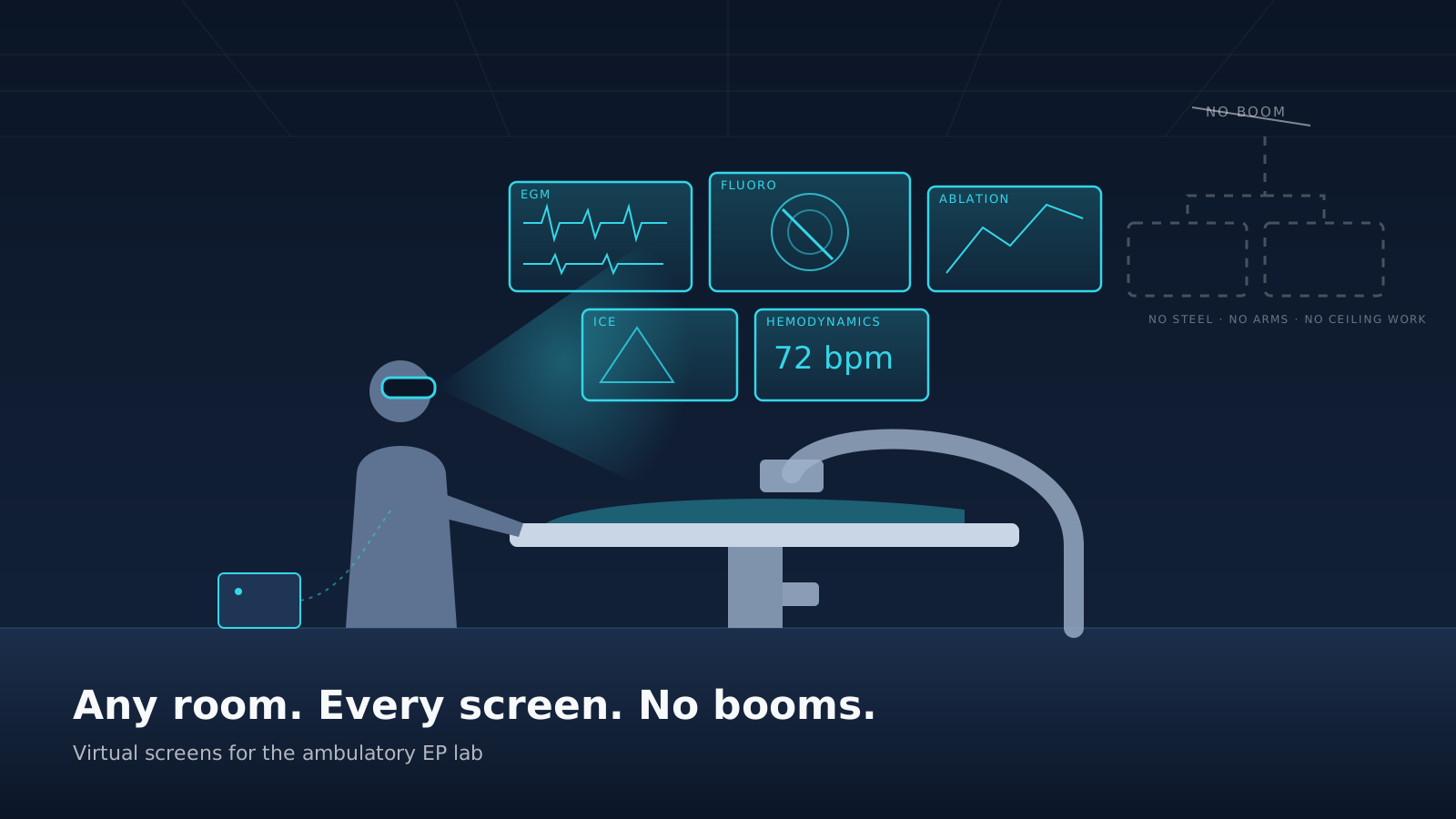
On January 1, 2026, Medicare began paying for cardiac catheter ablation in ambulatory surgery centers. For a cardiology group, that changes the question from whether an outpatient EP program is possible to what it costs to build one, and how much of that cost actually has to be spent.
This post covers both halves. First, which EP procedures have made the move, and which have not? Then, where capital goes in an EP room and why the display layer (the booms, arms, and ceiling structure that carry monitors) is the part an ASC no longer has to buy. For an ambulatory surgery center planning an EP program, virtual screens offer a reason to reconsider how many physical monitors, arms, and ceiling supports the room actually needs.
What has moved out of the hospital
The shift has been gradual. Device work came first. Pacemaker and ICD implants were already on Medicare’s ASC Covered Procedures List (CPL) before ablation was considered, alongside elective PCI and peripheral vascular interventions, and the Heart Rhythm Society used those procedures as the benchmark when it argued that ablation carried a comparable risk profile. CMS first allowed PCI in ASCs in 2020.
Ablation took longer. Earlier rulemaking cycles rejected requests to add it, often because ablation was non-surgical or insufficiently supported for the ASC setting. The CY 2026 final rule reversed that. CMS added six cardiac ablation codes and seven additional EP codes requested through public comment, effective January 1, 2026. The core codes are:
| CPT code | Procedure | Note for ASC planning |
|---|---|---|
| 93656 | Atrial fibrillation ablation with pulmonary vein isolation | Finalized ASC payment of $20,256 |
| 93653 | Supraventricular tachycardia ablation | Short, predictable cases |
| 93654 | Ventricular tachycardia ablation | Selected patients only; high-risk VT stays in the hospital |
| 93650 | AV node ablation | Often paired with a device implant |
Two factors drove the change. Same-day discharge after AF ablation went from rare to routine: fewer than 1 percent of patients went home the same day in 2016. Pulsed field ablation shortened and standardized the procedure; analysts expect PFA to be the first modality widely adopted outside the hospital, given its safety record.
Adoption is early but visible. In November 2025, the HRS and the ACC published a joint scientific statement on performing intracardiac ablation in ASCs, noting that only 7 percent of electrophysiologists were performing any ablation in an ASC at the time.
In practice: Clermont ASC
VistaMD is already in use in the ambulatory setting. In April 2026, SentiAR installed a system at Clermont ASC in Clermont, Florida, where it supported its first case that same month.
What stays in the hospital
Not everything belongs in an ASC, and the professional societies say so plainly. The HRS laboratory standards hold that procedures near the coronary arteries, such as aortic cusp and epicardial ablation, should not be performed outside a hospital, and that high-risk VT ablation in patients needing mechanical circulatory support requires a comprehensive hospital program. Lead extraction needs immediate surgical backup. The ASC case mix is appropriately selected AF, flutter, SVT and AV node ablation, plus device implants, in patients who meet same-day discharge criteria.
That matters for room design. An ASC EP lab is a room for high-volume, predictable cases. It should be built, and spent on, accordingly.
Where the money goes
ASC construction is expensive even before any EP equipment arrives. Current estimates put ASC build costs at roughly $500 to $900 per square foot, driven by operating-room HVAC, medical gas, and backup power. Industry leaders are candid that cardiovascular ASCs were not going to be built until Medicare reimbursement was assured, and that building a CV-focused facility or converting an office-based lab costs a great deal. Inside the room, the capital stacks up in layers: fluoroscopy, the electroanatomic mapping system, the recording system, ultrasound, the ablation generator, radiation shielding, and finally the displays that carry each of those outputs to the operator. The first five are the clinical core of the room. The last is infrastructure, and it is more expensive than it looks.
A conventional EP lab hangs its monitors from ceiling-mounted booms. Booms carry loads of 500 to 1,500 pounds and, when extended on an arm, create a bending moment on their supports, so each mounting point needs a structural engineer. They need clearance above the finished ceiling for the support steel and clearance below for movement. Wood-frame buildings may not carry them at all. And everything in the ceiling has to be coordinated with the C-arm’s own floor-to-ceiling requirements. One facility found that the cost of the support structure alone nearly matched the cost of the booms.
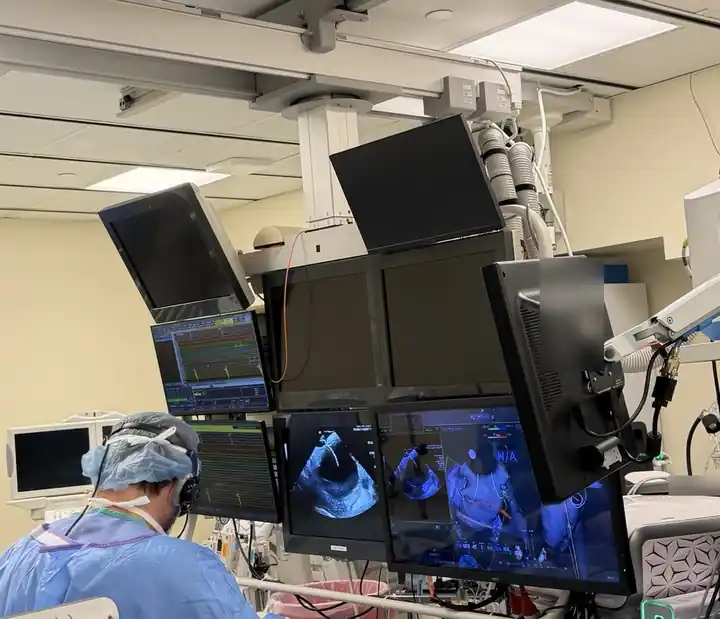
The conventional display layer: monitors hung from ceiling-mounted booms, each one dependent on structural support above the ceiling.
In SentiAR’s assessment, boom-mounted display systems often cost more than half a million dollars per room, and ceiling-mounted A/V accounts for 10 to 20 percent of total room cost. The exact figure varies by site; the direction does not.
Three rooms, one problem
A new EP lab. In a new build, the display layer is designed from the start: structural steel, ceiling coordination, and cabling to every monitor position. Each of those is a line item in the construction budget and a dependency in the schedule. Remove the booms, and the ceiling only has to serve the imaging system, lights, and shielding.
Modernizing an existing lab. Retrofitting is where boom costs are least predictable. Adding or relocating ceiling-mounted equipment can require opening the ceiling, reinforcing the structure, and taking the room offline. A room with sound imaging and mapping equipment but a display layout that no longer fits the procedures being performed does not need new steel to change how information reaches the operator.
A multi-specialty or inclusive OR. Many ASCs will not dedicate a room to EP on day one. A room shared with vascular, GI, or orthopedic work cannot be fitted out with fixed EP monitor positions that every other specialty must work around. In a shared room, the display configuration needs to be portable and tailored to the case, not built into the ceiling.
What VistaMD changes
VistaMD replaces the physical display layer with virtual screens rendered in an augmented reality headset. It brings up to five customized virtual screens, drawn from up to eight simultaneous inputs (EGMs, intracardiac echo, fluoroscopy, ablation parameters) and anchors them hands-free within the operator’s field of view. The headset is a Magic Leap 2; the sources connect via a compact hub rather than ceiling-mounted monitors.
The consequences follow directly from the three rooms above. A new room does not require boom steel or monitor arms. An existing room can be reconfigured in software rather than in the ceiling. A shared room becomes an EP lab when the EP team puts on the headsets and stops being one when they take them off.
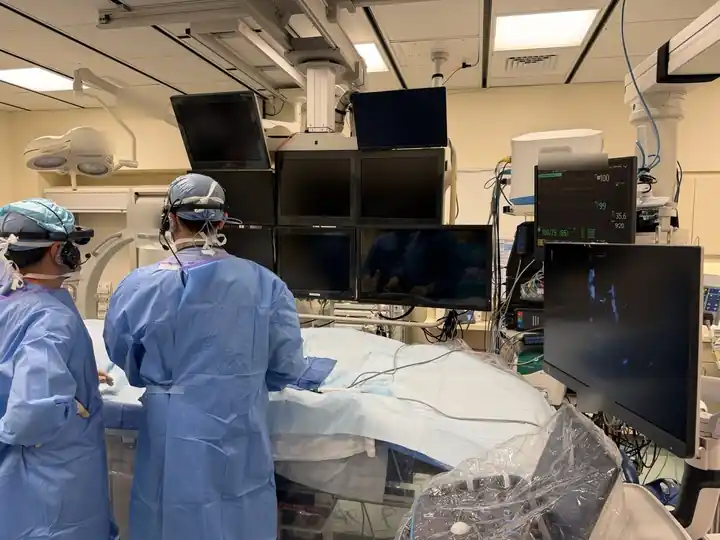
Two operators work from VistaMD virtual screens in their headsets. They both see the same images, although they can distribute them differently. They have the boom monitor off.
Two limits are worth stating. VistaMD does not replace the clinical core of the room. The fluoroscopy, mapping, recording, and ablation equipment are still required, and VistaMD displays their outputs. And the rest of the team still needs to see what they need to see; anesthesia and nursing workflows should be planned explicitly, not assumed.
Questions to settle before construction
A planning team evaluating virtual screens for an ASC EP lab should address a short list of questions before the drawings are finalized. Which inputs does the operator need, and do they fit within the system’s input count? Which displays do other team members need, and where? What does the room’s case mix look like in year one and year three, and will it be shared? What is the headset service and replacement plan? And what does the construction budget look like with and without the boom package, with the boom package priced as a line item by the architect for this building?
That last number is the business case. It is worth getting in writing.
See more. Know more. Do more.
SentiAR builds the world’s first real-time, multi-modal holographic AR platform, with real-time holographic guidance for cardiac electrophysiology. Two FDA-cleared products, based in St. Louis, Missouri.
Native EAMS-integrated visualization (CommandEP combined with VistaMD virtual screens) is not yet available for sale or delivery.
Sources
- Heart Rhythm Advocates, EP ablations added to the ASC-Covered Procedures List for CY 2026.
- Boston Scientific, Summary of CY2026 Medicare final rules for hospital outpatient and ASC.
- Becker’s ASC, The cardiology procedures added to the ASC-covered list.
- Heart Rhythm Society, comment letter on the CY 2025 ASC payment system, September 2024.
- Cardiovascular Business, Safety a top priority as more heart procedures move to outpatient settings, 2026.
- Shanker A, Jones S, Aryana A, et al. HRS/ACC Scientific Statement: Guiding Principles on the Performance of Intracardiac Ablation Procedures in Ambulatory Surgical Centers. JACC. 2025.
- Centers for Medicare & Medicaid Services. CY 2026 ASC payment system final rule and supporting policy files.
- MedTech Dive, CMS covers cardiac ablation in ambulatory surgery centers.
- Heart Rhythm Society, Expert Consensus Statement on Electrophysiology Laboratory Standards: Process, Protocols, Equipment, Personnel, and Safety. hrsonline.org.
- ASC News, Cardiovascular procedures opening up to ASCs, but expansion faces steep hurdles, February 2026.
- Commercial construction cost references, 2026: Frans Construction; Kafa Fab.
- AORN Outpatient Surgery, Selecting the right boom for your OR; DOTmed, hybrid OR ceiling infrastructure.